Project
Geometric Probability: The Equidistant Point Puzzle
A full derivation and visualization of a two-random-points probability problem
Overview
Two random points, one elegant question
Two points, red (R) and blue (B), are chosen uniformly at random inside a unit square. What is the probability that a point exists on the side of the square closest to B that is equidistant from both R and B?
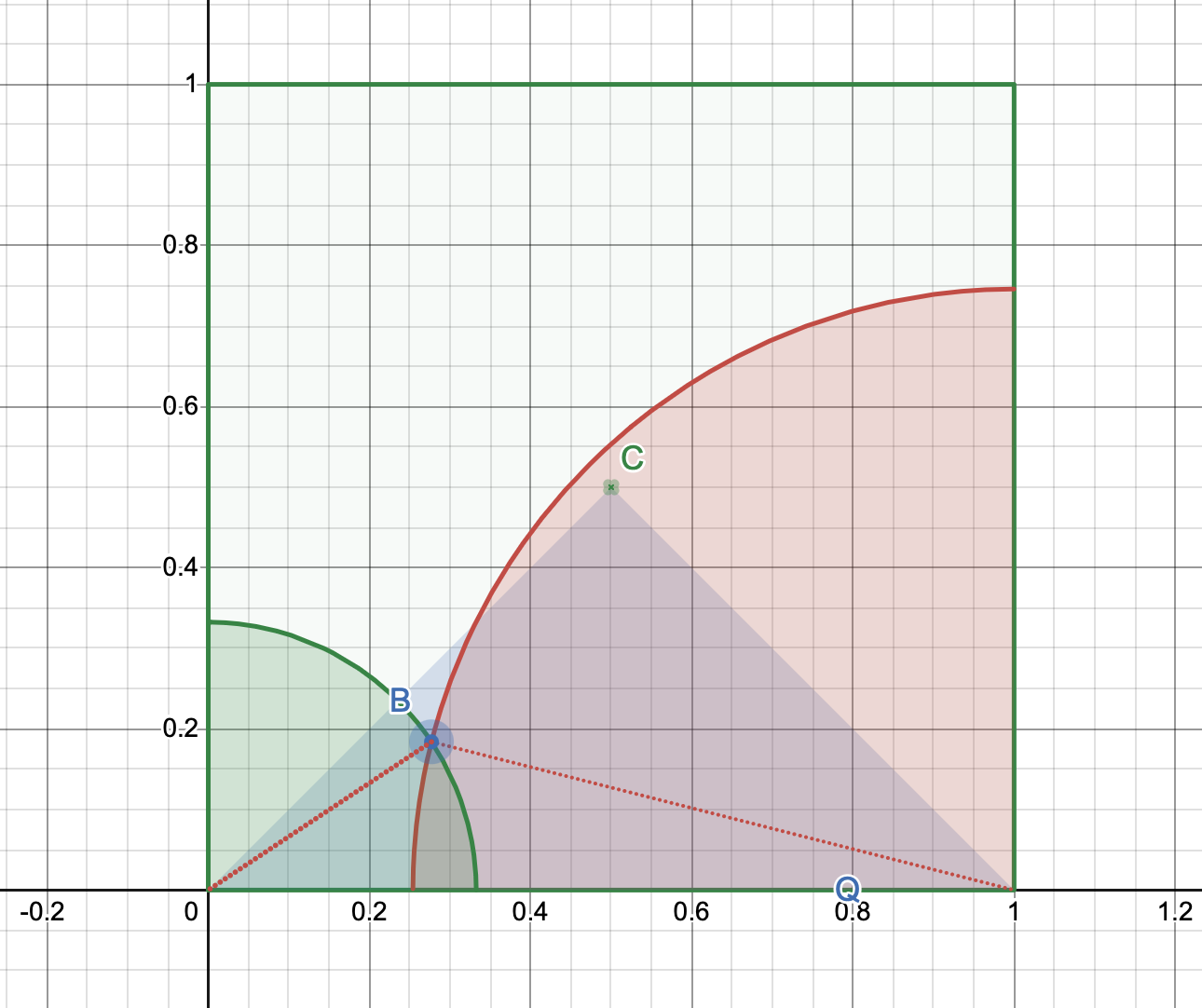
Rather than reaching for simulation, I worked through a full geometric derivation: identifying the locus of valid positions for R, computing the relevant sector and intersection areas, and reducing the final expectation to a closed-form integral using the square's eight-fold symmetry.
Approach
From locus to expected area
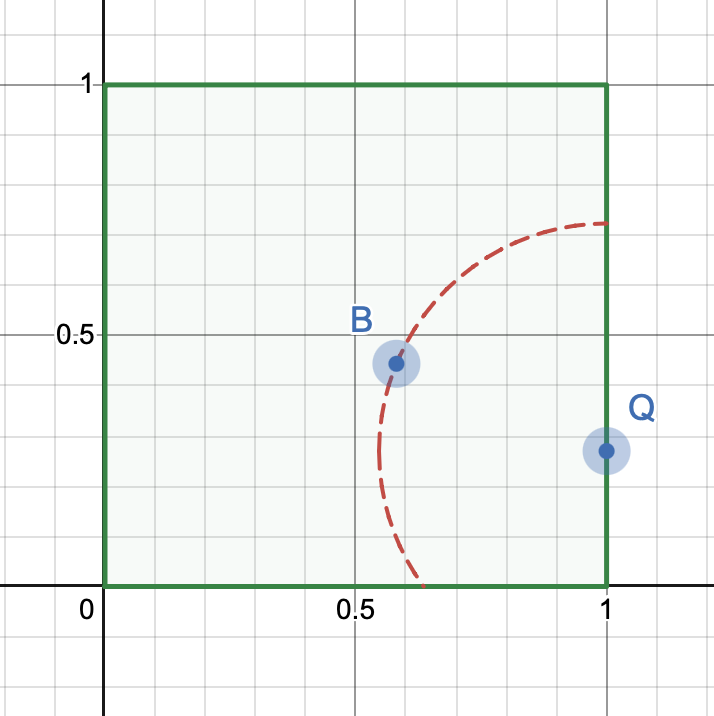
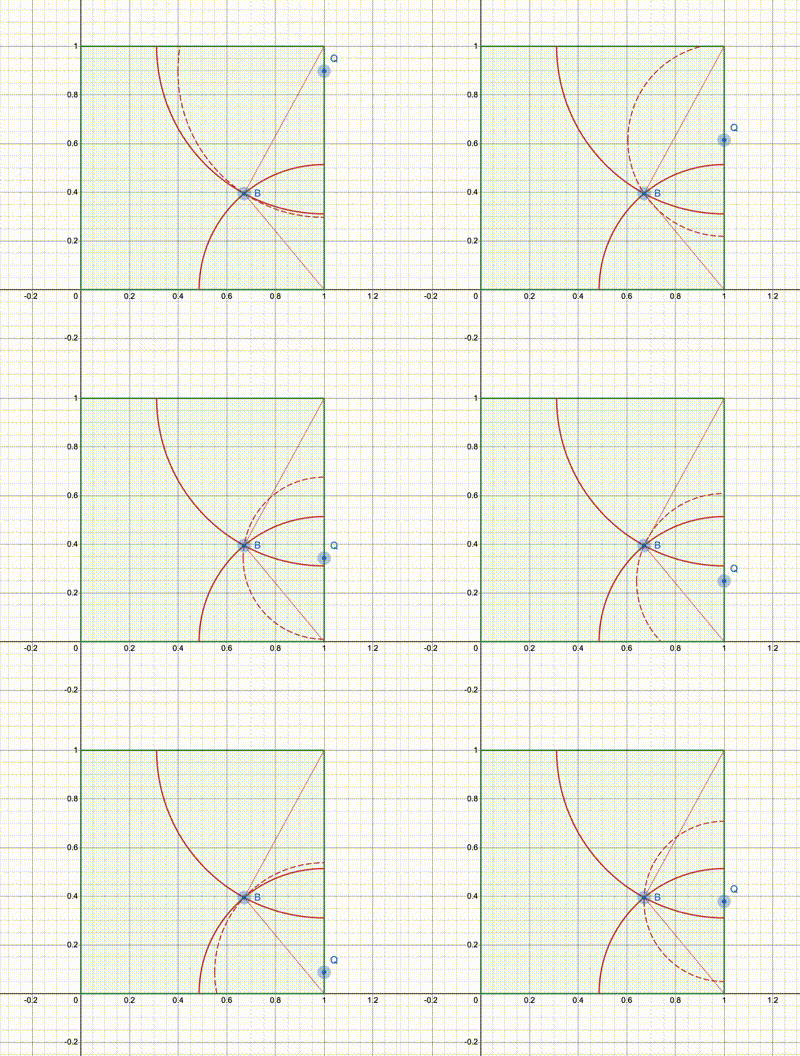
For any point Q on the side of the square closest to B, the locus of valid positions for R is an arc centered at Q. Sweeping Q across the whole side traces out the full region where R can exist for an equidistant point to be possible.
Locus of R per Q → sweep Q along the nearest side → sector + intersection area → expectation over B → 8-fold symmetry reduction
The probability that such a point Q exists, conditioned on B, turns out to equal the area of the valid region for R (since both points are uniform on the square). Averaging that area over all positions of B — and exploiting the square's diagonal and axis symmetries to only integrate over one of eight equivalent regions — produces a compact double integral for the final answer.
Gallery
Visualizing the locus and sweep
8-fold
Symmetry reduction used in the derivation
2
Random points modeled (R and B)
Closed-form
Double integral expressing the answer
Geometric
Locus + sector + intersection reasoning
Project details
Timeline
Role
Domain
Tools